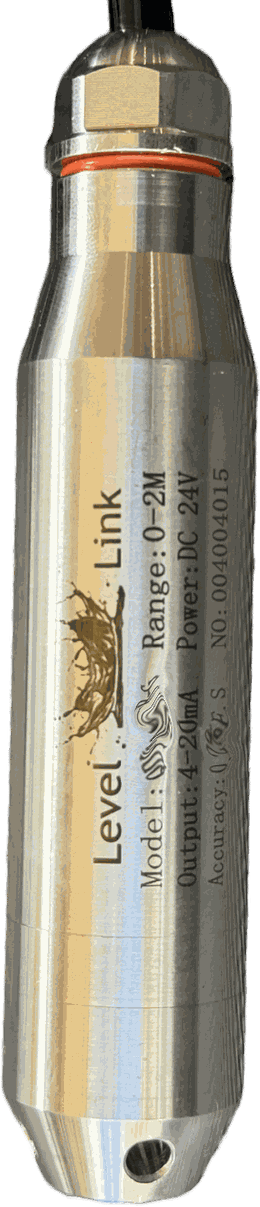
Accuracy
Measurement that holds its accuracy
Every electronic measurement is a comparison against a reference, and cheap references drift with temperature. A gauge built on one does not just measure your water — it accidentally measures the weather. The new board is built around a precision voltage reference specified at 2 parts per million per degree, so the same water level reads the same whether the pump shed is at 5 °C or 45 °C.
The sensing resistors are 0.1 % thin-film parts rated at 5 ppm per degree, five in parallel on each channel to share the heat and average out their individual tolerances. The whole conversion chain is now direct: the signal goes from the probe to the converter through a protected path, with no intermediate amplifier stage to add its own drift and offset. Fewer stages, fewer error sources.
What "accurate" means here. On a tank, the number that matters is not how deep the water is to the last millimetre — it is how much has moved. Measured in a real concrete tank, a LevelLink unit sitting in still water holds a noise floor of 0.01 to 0.03 mm. That is not a calculation: it is the observed standard deviation of a production unit in the ground. For reference, one step of the converter is 0.036 mm, so the instrument is effectively limited by its own arithmetic rather than by noise — there is nothing left to quieten.
That is what becomes a trustworthy litres figure. A single toilet flush steps the graph of a full-size tank, the washing machine and the stock trough are individually visible, and the slow overnight creep that means a leak shows up days before anyone hears the pump running dry. Enter your tank's litres per metre once and every one of those changes is reported in litres, not guesses. In the app a change has to clear about 0.9 mm before it is logged as a usage event — a deliberate margin, so that what you are shown is water actually moving and not the instrument talking to itself.
Integration
One board, no daughterboard
Earlier units converted the probe signal on a bought-in daughterboard, joined to the main unit by wiring. Every interconnect between two boards is an opportunity for outside electrical noise to find its way into a sensitive measurement, and off-the-shelf modules are designed for general use rather than for sitting on a tank at the end of a long cable run. Designing the conversion onto our own board removed that exposure rather than filtering around it.
The complete conversion chain now lives on one board over a solid ground plane, with signal paths measured in millimetres rather than centimetres of loose cable. Shorter paths are quieter; fewer connectors means fewer things to corrode or work loose.
Interference
Filtered on every line that leaves the box
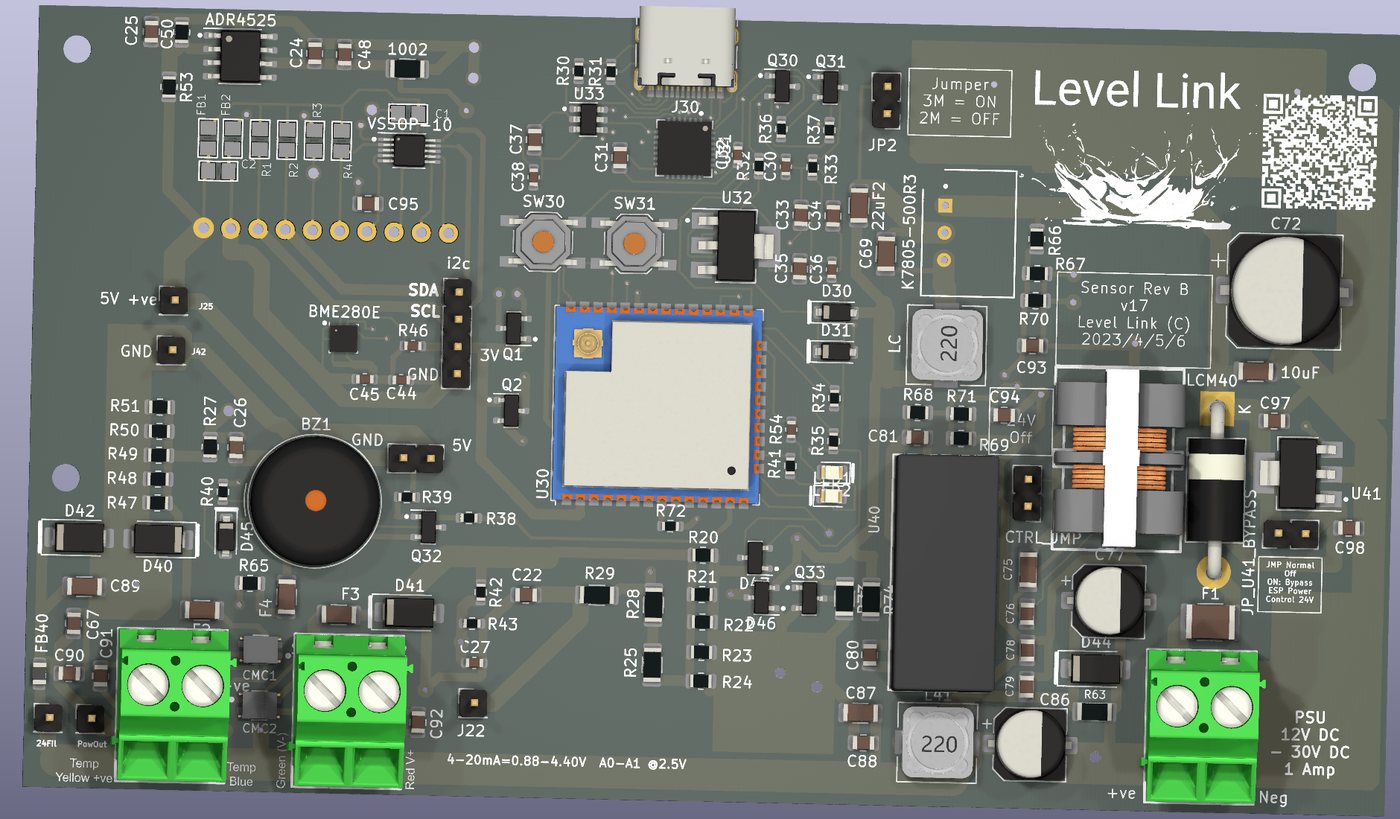
Look along the terminal blocks in the render above and the filtering is visible as hardware: a choke sitting on every pair that crosses the enclosure wall. Earlier boards filtered the incoming supply and left the sensor lines bare. This one filters everything that goes in or out.
Ten metres of cable to a tank is an aerial whether you want one or not, and it works in both directions: it can pick radio energy up and inject it into the measurement, and it can carry the electronics' own switching noise back out into the world. A tank gauge has to be a good neighbour in both senses.
- Input: a 10 mH common-mode choke with 1 kV of coil-to-coil isolation, which also creates a separate filtered ground island inside the box so incoming mains-side noise never shares a return path with the measurement.
- Sensor pair: its own automotive-qualified choke, 1000 Ω at 100 MHz, mounted hard against the terminal block.
- Temperature pair: an identical choke of its own, again at the block.
Each output choke is paired with a line-to-line capacitor on the cable side, deliberately with no connection to ground, so high-frequency energy is shorted between the two wires of the pair rather than dumped into the enclosure. The chokes sit at the terminals rather than somewhere convenient on the board, because filtering is only worth anything at the point where the wire enters.
The practical result: the tank gauge does not interfere with your radio or television, and your neighbour's does not interfere with the tank gauge.
Protection
Protection where the damage actually happens
Three self-resetting fuses
One on the power input and one on each sensor line. A crushed cable, a flooded junction box or a shorted probe trips the fuse in a fraction of a second and the board waits. Clear the fault and the fuse resets itself — no spares, no soldering iron, no call-out.
Surge clamps at the point of entry
A cable running out to a tank is a long wire across your property, and a strike hundreds of metres away can induce a spike in it. Every field terminal is clamped, and the clamps sit downstream of the fuses on purpose: surge current has to pass through the fuse, so a sustained fault trips it instead of cooking the clamp. The 24 V rails carry their own 400 W suppressors.
Wired-it-backwards insurance
Everyone reverses a supply eventually, usually at dusk, usually in the rain. A series protection diode on the input means reversed wiring is a non-event: the board refuses the bad power and sits unharmed until you swap the leads.
Isolated 24 V supply
The probe loop runs from an isolated converter that accepts anything from 9 to 36 V in, so a long low-voltage cable run with some volt-drop in it still delivers a clean, regulated loop supply at the tank.
Diagnostics
A sensor that watches itself
A flat line on a graph is the worst kind of answer: is the tank empty, the probe dead, or the cable cut? The new hardware measures the health of the sensor loop continuously and reports named fault states. Your first look at the app tells you not just that there is a problem but which problem, and therefore which tool to bring.
The board watches three supply rails independently — the 3.3 V logic rail, the 12 V input and the 24 V sensor loop — and reads the actual current flowing in the probe loop rather than inferring it. Each has its own named failure:
Is the probe there at all?
No current in the loop is Probe disconnected — a pulled wire or a cut cable. Too little is Under range, which is a failing transmitter or water in a junction. Too much is Over current, a short somewhere in the run. Three different repairs, three different messages.
Is the supply good enough to believe?
A 4–20 mA loop running on a sagging rail reads wrong rather than reading nothing, which is far more dangerous. The loop supply is checked before a reading is accepted, and a rail that has collapsed produces Input supply low instead of a plausible, wrong number.
Is water getting into the box?
The enclosure sensor flags rising humidity long before it becomes corrosion — an early warning that a gland or the lid seal has started to let go, while the fix is still a two-minute tighten.
Would rather say nothing than lie
This is the important one. When a reading cannot be trusted the device does not publish the last good value to keep the graph tidy — it posts nothing and sends the reason instead. A gap in the trace is honest. A flat line that is really a stale number is not.
Faults in the critical class also sound the siren at the tank, because some problems should not wait for somebody to open an app.
Temperature
Water temperature, on the same cable
A second, fully independent industrial 4–20 mA input runs alongside the level channel. With a temperature-equipped probe you get live water temperature on the same cable run — no extra wiring, no second device. It is also used internally, and that turns out to matter more than it sounds.
Why a concrete tank needs no correction, and a poly tank does
A pressure probe on the floor of a tank measures the weight of the water above it. Warm the water and it expands — but it gets taller by exactly as much as it gets less dense, so the weight pressing on the bottom is unchanged. Pressure measures mass, not volume, and warming the water did not add or remove any. In a rigid tank the two effects cancel perfectly and temperature simply does not enter into it.
A poly tank breaks that, because the tank moves. Plastic walls flex outward as they warm, the tank becomes fractionally wider, and the same water settles lower inside it. Nothing has been drawn off, but the level reads lower — and then reads higher again overnight as the walls cool and draw back in. On a hot day that daily breathing can be mistaken for usage followed by a refill that never happened.
The effect scales with how much wall there is relative to how much water. A small poly tank moves proportionally more than a large one, which is why a 1,000 litre garden tank can show a daily swing that a 30,000 litre tank never would.
Setting Tank Type to Poly switches on a temperature-keyed correction for exactly this, using the water temperature already arriving on the second channel. Concrete and metal tanks are left alone, because for them the physics already cancels and a correction would only add error. Separately, and always on, the probe's own zero drifts slightly with temperature; that is characterised per family and compensated whatever the tank is made of.
Enclosure
Enclosure health monitoring
Electronics in outdoor boxes have one true enemy, and it is not heat — it is moisture. An onboard Bosch environmental sensor watches temperature, humidity and barometric pressure inside the sealed enclosure. Rising internal humidity is the early signature of a gland or seal beginning to fail, and LevelLink flags the trend while the fix is still a two-minute tighten rather than a corroded board.
In the field
Built for where tanks actually are
External antenna
Tanks live at the far end of the yard, behind the shed, past the trees. The module uses a proper external antenna through the enclosure wall rather than a trace etched on the circuit board. More signal, more margin through rain and foliage.
Alarm siren and status LED
Some faults should not wait for you to open an app. A piezo sounder driven from the 24 V rail announces critical sensor faults on the spot, and a status LED gives at-a-glance health every time you walk past.
Power
What makes running on a battery possible
The single-board design is what brought solar and battery operation within reach, and it is not simply a matter of drawing less. The sensor loop is the expensive part: an industrial 4–20 mA transmitter wants its 24 V supply continuously, and continuously is what flattens a battery.
So the new board can switch the sensor loop off entirely between readings and bring it back only when a measurement is due. That is where nearly all the saving comes from. It also creates three problems that had to be solved before the readings could be trusted:
- A supply coming back up is not yet a supply you can measure on. The firmware qualifies the 24 V rail before it will accept anything from the probe — repeated samples above threshold, not one hopeful glance. A 4–20 mA loop on a half-risen rail returns a number that looks entirely reasonable and is wrong, which is worse than returning nothing.
- A transmitter that has just woken reads low. Its electronics warm for twenty to thirty minutes before settling, and the reading climbs the whole time. The firmware knows the shape of that curve, works out how long this particular transmitter has been powered, and corrects for where on the curve it currently sits — so the first reading after a wake is as good as the last one before it slept.
- A reading that fails any of those checks is not published. It reports the reason instead. Battery mode does not get to be quietly less accurate than mains.
The result is a unit that wakes, powers its probe, satisfies itself the measurement is real, reports it and shuts the loop down again — typically inside a couple of minutes, several dozen times a day, on a panel you could carry under one arm.
Add-on
No power at the tank? Run it on the sun.
The box runs from 12 V, so a solar panel with a battery in it does the whole job — no trench and no cable run back to the house. Any 12 V panel-and-battery combination is a candidate; the one we have run in the field is about $99 for a 10 W panel and a 59 Wh pack.
The thing that decides whether it works is not the panel. It is how often the unit reports.
| Mode | Draw | On a 59 Wh pack, no sun |
|---|---|---|
| Mains — continuous reporting | 1.5–2.5 W | About 2 days — measured at 49 hours |
| Battery — reporting every 15 min | 0.3–0.4 W | 4–5 days |
| Battery — 15 min, deep sleep on | 0.2–0.25 W | About 8 days |
Continuous reporting flattens the pack in two days, so it is not a solar proposition. Reporting every fifteen minutes draws roughly 8 Wh a day, which even a small and partly shaded panel gathers comfortably — our test panel sits in afternoon-only sun and still keeps ahead. The days above are the reserve you hold if the sun never appears at all.
You still need WiFi at the tank. Solar removes the power run, not the network. Without WiFi you get a local Bluetooth reading standing at the tank, but no reporting, no history and no alerts.
On your network
The device serves its own control page
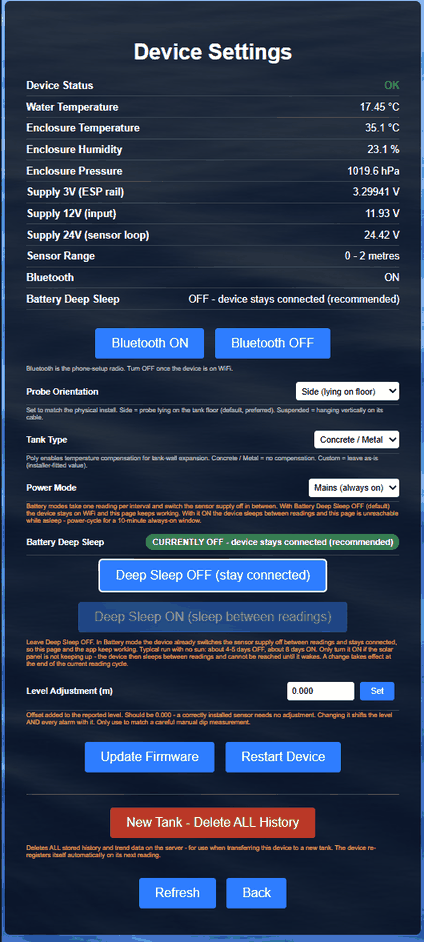
Type the unit's address into a browser on the same WiFi and this is what answers — served by the device itself, on your network, with nothing in between. No account, no cloud round trip, and it keeps working whether or not our servers are up.
- The same numbers the firmware uses. Three supply rails, water temperature, and the enclosure's own temperature, humidity and pressure. These are not a summary for display — they are the readings the device itself checks before deciding whether to trust a measurement.
- Tank type and orientation. Poly switches on the wall-expansion correction described above. Orientation tells it whether the probe lies on the floor or hangs on its cable.
- Power mode. Mains, or a battery cadence from five minutes to two hours, with deep sleep as a separate choice — the controls behind the solar figures above.
- Level adjustment, with a warning attached. It should be zero. A correctly installed sensor needs no trim, and the page says so rather than presenting it as a knob to play with.
- Firmware and history. Update, restart, and a deliberately awkward "New Tank" control that clears all stored history when a unit moves to a different tank.
Ownership
Your device, and only your device
Every unit generates its own secret credential the first time it powers up — a key that never existed at the factory and is never shown to anyone. From that point the LevelLink server accepts readings for your device only from your device. Nobody can impersonate your sensor, feed you fake readings, or tamper with your history.